anno venticinquesimo - LUGLIO 2026
registrata presso il Tribunale di Milano
n.330 del 22/05/2007
By Sergio Zabot, adjunct professor at Politecnico di Milano.
Drafted in the context of the International Conference: Regional Plans for Climate Adaptation and Implementation of Energy Policies, SESSION III – Mitigation - Financing of Energy Efficiency for Public Authorities.
Dibattito aperto su strumenti e servizi di facilitazione (MLEI, ELENA, ...) per gli investimenti di efficienza energetica nei comuni. Pescara - 29 Settembre 2016
a cura di Sergio Zabot, Politecnico di Milano
Redatto nel contesto della Conferenza Internazionale: Piani Regionali di Adattamento Climatico e Attuazione di Politiche Energetiche, Sessione III - Mitigazione - Finanziamenti di Misure di efficienza Energetica per le Autorità Pubbliche
Participants:
Graziano D'Eustachio AGENA Teramo, (MLEI, PARIDE)
Massimo Gattolin Città Metropolitana di Venezia, (ELENA, Amica-e)
Julije Domac REGEA, (ELENA, Newlight, County of Zagreb and Krapina Zagorje)
Antonio Di Nunzio Province of Chieti, A.L.E.S.A. , (ELENA, Energy Efficiency in Province of Chieti)
Vlasta Krmelj ENERGAP, (Municipalities involved in the Streetlight-EPC project)
Moderator: Sergio Zabot, Politecnico di Milano
-------- o --------
Synthesis of investment programmes discussed
AGENA Teramo, (MLEI, PARIDE)
Name of the project: PARIDE – Provincial Technical Assistance for Investments and Development of Energy Efficiency.
Starting date: 01/10/2012; Ending date: 30/09/2015, extended to 31/12/2016.
Beneficiary: Provincia di Teramo + 32 Municipalities of the Province.
Objectives: Provide technical and legal assistance for the preparation of tenders aimed at retrofitting public lighting installations (≈ 53,000 lighting points).
Expected results: investments for upgrading and retrofitting of equipment for 16 million euro, with a reduction of electricity consumption by at least 44%; reduction in CO2 emissions of at least 6,800 t / year; reduction of primary energy consumption of at least 2,600 toe /year.
Città Metropolitana di Venezia, (ELENA, Amica-e)
Name of the project: AMICA-E: Azioni Metropolitane Inter Comunali per l’Ambiente e l’Energia (Metropolitan Inter Municipal Actions for the Environment and Energy).
Starting date: 01/01/2016; Ending date: 31/12/2018.
Beneficiary: Metropolitan City of Venice (former Province of Venice).
Objectives: energy renovation of 122 public buildings; install 48 photovoltaic systems; refurbish 20 public lighting networks on 25 Municipalities in the Venice Metropolitan Area.
Expected results: 36.2 M€ investments broken down as follows: 10.2 M€ investments on buildings retrofitting (heating generation and distribution, insulation, windows); 2.5 M€ investments on RES – photovoltaic plants on public buildings; 23.5 M€ investments on PL retrofitting (lamps substitution, energy saving systems).
Energy savings and CO2 emissions reduction: 17 000 MWhTH reduced; 1 100 MWhEL produced, a total of 7.100 tCO2 avoided.
REGEA, (Newlight, County of Zagreb and Krapina Zagorje)
Name of the project: NEWLIGHT, EIB overall technical assistance. It is a pioneering project for Croatia when 57 political entities participate together under one project umbrella with the help of 2 regions (counties) through the regional energy agency – REGEA.
Beneficiary: North-West Croatia Regional Energy Agency (REGEA).
Starting date: October 2015 - Ending date: October 2018.
Objectives: Main goal of the NEWLIGHT project is to trigger ESCO market in Croatia by promoting Public Private Partnership (PPP) as a main financial source for the reconstruction and modernization of a public lighting in 57 local authorities (project partners).
Expected results: € 20 million investment for 34 000 lighting points refurbishment.
Expected savings: 9,5 GWh of electric energy savings yearly (2 800 tons of CO2 equivalent avoided yearly.
Province of Chieti, and from A.L.E.S.A. , Antonio Di Nunzio (ELENA, Energy Efficiency in Province of Chieti)
Name of the project; CHIETI TOWARDS 2020 - CONTRACT ELENA 2010
Starting date: 01/01/2012 - Ending date: 31/12/2015
Beneficiary: Province of Chieti and ALESA (Energy Agency)
Objectives: Energy savings: 36 GWh; reduction of CO2 emissions: 13.000 t/y
Main results: Investment achieved € 37.887.389
Estimated energy savings: 37 GWh/y
Estimated reduction of CO2 eq.: 5.143,03 t/y
ENERGAP, Podravje (Slovenia) - (Municipalities involved in the Streetlight-EPC project)
Name of the project : “Street light – Energy Performance Contracting”, Intelligent Energy Europe Programme
Starting date: April 2014 - Ending date: March 2017
Beneficiary: OÖ Energiesparverband (ESV) on behalf of 9 EU regions.
see: ec.europa.eu/energy
Objectives: establishing Energy Performance Contracting (EPC) markets in 9 EU regions through regional EPC facilitating services.Expected results: implement 36 EPC Street light projects, triggering 49 mio EUR investments, some indoor lighting projects and few EPC projects in buildings.
Expected savings: annual energy savings of 32 GWh and budget relief of 4.8 mio EUR, inducing 18 SMS in becoming ESCO, transferring the experiences to other sectors (buildings and industry).
Synthesis of lesson learned and critical issues still existing in performing the investment programmes according to the different activities as shown in the table:
Sintesi delle lezioni imparate e delle criticità ancora esistenti nell'attuare le diverse attività dei programmi di investimento, come illustrato nello schema:
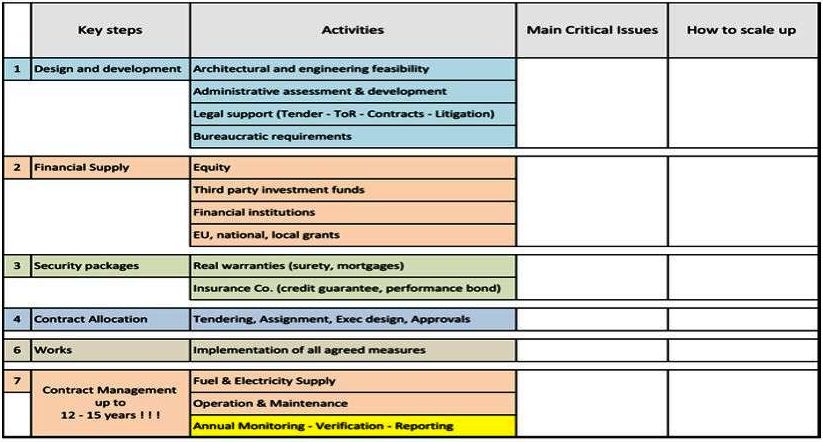
The Baseline, especially with regard to energy consumption in buildings, are often unreliable (D'Eustachio, Domac, Di Nunzio). It is fundamental to have meaningful and accurate inventories of the buildings, facilities and the existing street lighting system as well as good quality and well standardized audit to determine reliable numbers on potential savings.
The renovation projects of public lighting systems are much simpler and easier to prepare and to implement (Domac).
Although energy diagnostic studies and projects are generally of good quality, the resources required for technical and engineering aspects are often underestimated (Vlasta Krmelj).
The time for preparation and approval of projects are particularly long and the participation of individual municipalities may vary during long waits. In buildings in particular, it happens that during the waiting time, the municipalities undertake interventions with high savings and low Pay-Back (typically replacement of boilers), compromising the possibility to realize the so-called "deep renovation" (Gattolin, D'Eustachio).
Many of the Public Private Partnership agreements originate from political agreements, typically for major investments. However the duration of the programs in the field of energy, can reach 10-15 years, which largely exceeds the times of political mandates, typically five years. Ergo, "political incursions" in the on going operating / management programs can be devastating for large and complex scale projects (Gattolin).
There is still a high interest in the EPC, but a lack of knowledge of the instrument. There are still many gaps on technical, economic and especially financial aspects. Specifically, financial institutions tend not to accept the cash flow generated by energy savings as the main collateral and therefore they adopt stricter precautions to the ESCo against the risk of insolvency. On the other side of the Small and Medium ESCo, not capitalized enough to handle long and complex contracts, have, therefore, difficult access to bank credit (Vlasta Krmelj).
Major ESCOs, well-capitalized and well placed in the public market, tend to boycott the tenders for EPC with Results Guarantee and prefer "All-inclusive contracts" (refurbishment, O & M, fuels supply) without accounting separation and without complete transparency. This leads to difficulties in tenders for upgrading the energy efficiency of the building stock, with a high risk of void tenders. As regards the tenders for public lighting, the difficulties are concretely minors (Di Nunzio).
Also there are many prejudices within the public administrations that need to be overcome proactively providing reliable information. Otherwise, they will continue to block decisions for EPC (Domac).
Finally, many municipalities are still inadequate to comply with appropriate trade-off between Governance improvement and Sharing of Sovereignty, necessary and implicit in Public Private Partnerships. In fact, the main phase of “Obligation to Perform” an Energy Saving Guaranteed Contract, requires the understanding and the application of a Monitoring & Verification protocol, not always fully implemented (Zabot).
Le Baseline, soprattutto per quanto concerne i consumi di energia degli edifici risultano spesso inaffidabili (D’Eustachio, Domac, Di Nunzio). Si ritiene fondamentale disporre di inventari significativi e accurati degli edifici, degli impianti e dei sistema esistenti di illuminazione stradale, nonché audit di buona qualità e ben standardizzati per determinare numeri affidabili sulle potenzialità di risparmio.
I progetti di riqualificazione degli impianti di illuminazione pubblica risultano decisamente più semplici e più facili da preparare e da implementare (Domac).
Sebbene le indagini diagnostiche e I progetti siano generalmente di buona qualità, le risorse necessarie per gli aspetti tecnici e ingegneristici sono spesso sottovalutate (Vlasta Krmelj).
I tempi di preparazione e approvazione dei progetti risultano particolarmente lunghi e le adesioni dei singoli Comuni possono variare durante le attese (Gattolin, D’Eustachio). Nell’edilizia in particolare, capita che durante i tempi di attesa, i Comuni effettuino interventi con alti risparmi e bassi Pay-Back (tipicamente sostituzione di caldaie), compromettendo la possibilità di realizzare la cosiddetta “deep renovation” (Gattolin).
Molti accordi di Partenariato Pubblico Privato originano da accordi politici, tipicamente per gli investimenti maggiori. Tuttavia la durata dei programmi importanti nel campo dell’energia, può arrivare a 10-15 anni, superando abbondantemente i tempi dei mandati politici, tipicamente di 5 anni. Ergo, eventuali “incursioni politiche” nei programmi operativi/gestionali in corso possono risultare devastanti per i progetti di grosse e complesse dimensioni (Gattolin).
C’è comunque un alto interesse per gli EPC, ma una scarsa conoscenza dello strumento. Esistono ancora molte lacune sugli aspetti tecnici, economici e soprattutto finanziari. In particolare gli istituti finanziari tendono a non accettare il cash flow generato dal risparmio energetico come collaterale principale e pertanto adottano precauzioni rigide verso le ESCo contro il rischio di insolvenza. D’altro lato le Piccole e Medie ESCo, non hanno capitalizzazioni sufficienti per gestire contratti lunghi e complessi e hanno, di conseguenza, difficoltà di accesso al credito bancario (Vlasta Krmelj).
Le ESCo maggiori, ben capitalizzate e bene inserite nel mercato pubblico, tendono a boicottare le gare per EPC con Garanzia di Risultato … in quanto preferiscono contratti “All-inclusive” (riqualificazioni, O&M, fornitura combustibili) senza separazione contabile e … senza completa trasparenza. Questo comporta difficoltà nelle gare per la riqualificazione energetica degli stock edilizi, con forti rischi di gare disertate. Per quanto riguarda le gare per l’illuminazione pubblica, le difficoltà sono concretamente minori (Di Nunzio).
Inoltre ci sono molti pregiudizi che hanno bisogno di essere superati proattivamente fornendo informazioni affidabili. In caso contrario, essi continueranno a bloccare le decisioni a favore di EPC (Domac).
Infine, molti Comuni sono ancora inadeguati ad ottemperare appropriati trade-off tra miglioramenti di Governance e condivisione di Sovranità, necessari e impliciti nei Partenariati Pubblico Privati. Infatti, la fase di gestione dei contratti, che può durare 10-15 anni, impone il controllo delle prestazioni ottenute, richiedendo la conoscenza e l’applicazione di un protocollo di Monitoraggio e Verifica, non sempre pienamente applicate (Zabot).